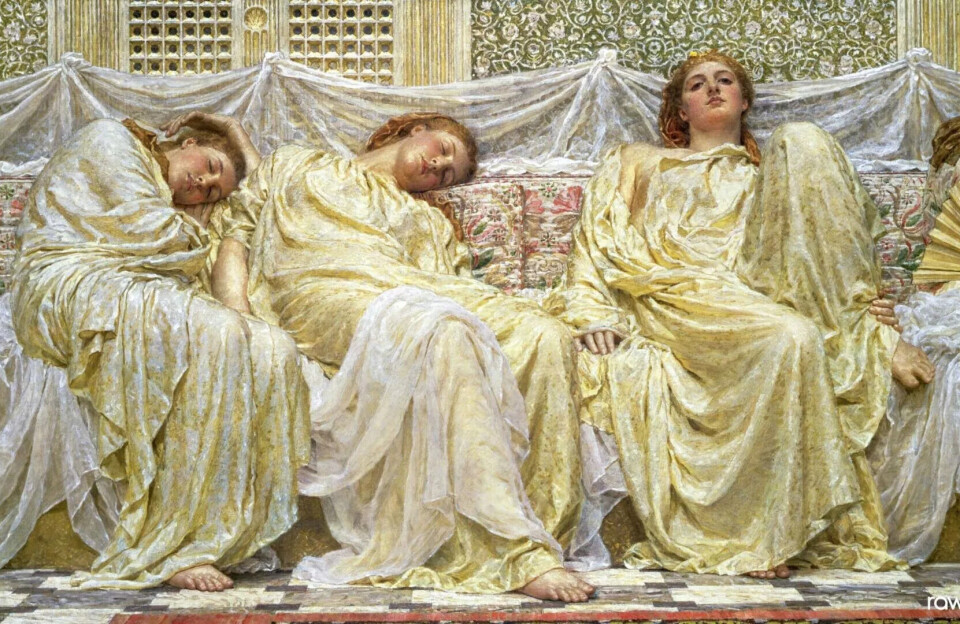
Consistent nightly sleep is a modern invention, not an evolutionary constant.
This may explain why many of us still wake up at three in the morning wondering if something is wrong.
It can be comforting to know that this is a deeply human experience. For most of human history, eight hours of uninterrupted sleep per night was not the norm. Instead, people typically slept in two shifts each night, often called 'first sleep' and 'second sleep'. Each period lasted several hours, separated by a wakeful period of an hour or more in the middle of the night.
Historical sources from Europe, Africa, Asia, and elsewhere describe how families went to bed early after dark, woke up around midnight for a while, and then slept on until dawn.
The middle interval was not a waste of time
This division of the night probably changed our experience of time. The silent interval gave the night a clear center, which could make the long winter evenings less interminable and easier to handle. The midnight interval was not wasted time, but 'observed' time, which shaped how the long nights were experienced.
Some got up to take care of chores like stirring the fire or looking after the animals. Others stayed in bed to pray or reflect on the dreams they had just had.
Letters and diaries from pre-industrial times describe how people spent the quiet hours reading, writing, or even enjoying quiet time with family or neighbors. Many couples also took advantage of this nocturnal wakefulness for a bit of lovemaking.
Literature dating back to the ancient Greek poet Homer and the Roman poet Virgil contains references to "an hour that ends the first sleep," showing how widespread the two-part night was.
How we lost that 'second sleep'
The second sleep disappeared over the past two centuries as a result of profound social changes.
Artificial light is one of the main reasons. In the 18th and 19th centuries, first oil lamps, then gaslight, and finally electric light began to transform the night into usable waking time. Instead of going to bed shortly after sunset, people began to stay up late into the evening in the glow of lamplight.
Biologically, the bright light in the evening also shifted our internal clock (our circadian rhythm) and made the body less likely to wake up after a few hours of sleep.
The timing of light matters a lot. Ordinary light before bed suppresses and delays melatonin, pushing sleep later.
The Industrial Revolution changed not only how people worked, but also how they slept. Factory schedules called for a single, unified sleep block.
Two sleep periods come naturally to us
By the early 1900s, the idea of eight uninterrupted hours had replaced the centuries-old pattern of two sleep periods. But in longer-term sleep studies, where long winter nights are simulated in darkness and clocks and artificial light are removed in the evening, participants often end up falling back into two-part sleep with a quiet wake interval.

A 2017 study of a farming community in Madagascar without electricity found that people there still mostly slept in two segments and got up around midnight.
Light controls our internal clock and affects how quickly we perceive time to pass. When these signals are weakened – such as in winter or under artificial light – it begins to flow.
In winter, later and weaker morning light makes it more difficult to maintain a circadian rhythm. Morning light is particularly important for regulating the circadian rhythm because it contains a greater amount of blue light, which is the most effective wavelength for stimulating the body's production of cortisol and suppressing melatonin.
In time-isolated laboratories and cave experiments, people have lived for weeks without natural light or clocks – some even in constant darkness. Many subjects misjudged how many days had passed, demonstrating how easily our sense of time slips when light signals disappear.
People from high latitudes cope with the Arctic winter
Similar shifts occur during the polar night, where the absence of sunrise and sunset can make it feel as if time does not exist at all. People born and raised at high latitudes and residents with regular routines often handle polar light conditions better than visitors, but the effect varies by population and context. It helps when an entire society shares a stable circadian rhythm.
A 1993 study of groups of Icelanders and their descendants who had emigrated to Canada showed an unusually low incidence of seasonal affective disorder (SAD).
The researchers suggested that genetic factors may help this population cope with the long Arctic winter.
Abonnementer
Sermitsiaq.gl - web artikler
- Adgang til alle artikler på Sermitsiaq.gl
- Pr. måned kr. 59.00
- Pr. år kr. 650.00
Sermitsiaq - E-avis
- Adgang til Sermitsiaq e-avis som udkommer hver fredag
- Adgang til alle artikler på Sermitsiaq.gl
- Pris pr. måned kr. 191
- Pris pr. år kr. 1.677
AG - Atuagagdliutit E-avis
- Adgang til AG - Atuagagdliutit e-avis som udkommer hver onsdag
- Adgang til alle artikler på Sermitsiaq.gl
- Pris pr. måned kr. 191
- Pris pr. år kr. 1.677
Sermitsiaq.AG+
- Adgang til AG - Atuagagdliutit e-avis som udkommer hver onsdag
- Adgang til Sermitsiaq e-avis som udkommer hver fredag
- Adgang til alle artikler på Sermitsiaq.gl
- Adgang til Arnanut e-magasin
- Adgang til Nutserisoq.gl
- Ved interesse send en mail til abonnement@sermitsiaq.gl
Kære Læser, Velkommen til Sermitsiaq.gl – din kilde til nyheder og kritisk journalistik fra Grønland. For at kunne fortsætte vores vigtige arbejde med at fremme den frie presse og levere dybdegående, kritisk journalistik, har vi indført betaling for udvalgte artikler. Dette tiltag hjælper os med at sikre kvaliteten af vores indhold og støtte vores dygtige journalister i deres arbejde med at bringe de vigtigste historier frem i lyset. Du kan få adgang til betalingsartiklerne fra kun kr. 59,- pr. måned. Det er nemt og enkelt at købe adgang – klik nedenfor for at komme i gang og få fuld adgang til vores eksklusive indhold. Tak for din forståelse og støtte. Dit bidrag hjælper os med at fortsætte vores mission om at levere uafhængig og kritisk journalistik til Grønland.